
Product Description
Spline milling shaft 87 Twin Screw Extruder Machine Parts 1.2343 Material Shaft
We manufacture both spline milling screw shafts and cold rolling shaft. Ranging from 10 mm to 120 mm /Length 500-900mm and over. Involute inner spliner. 1.2343 is Pre-hard Material import from Germany. and heat treatment also in Germany HRC38-42.Twin Screw Shaft Plastic Extruder Screw Design Extruder Screw Parts 87. The torque coefficient can meet 12.
Production description:
|
TEX160 Wear Resistance Screw Elements and Milling Shaft for Twin Screw Extruder Provide parts for companies such as Berstorff, Leistritz, W&P,JSW, Kobe and CHINAMFG to just name a few. 1. Details of products
2. Example drawing of shaft 3. Kinds of Materials of shafts:
3. Detail introduction of some shaft materials:
4. Types of shaft to choose: Single keyway Square keyslot High torque key button Dual keyslot 5. Torque of spline shaft 6. Materials of screw elements
Joiner has over 130 advanced equipments such as CNC thread grinder, CNC thread milling, CNC kneading block grinder, CNC forming milling, 4-axis machining center, automatic deep hole grinder, CNC lathe, CNC surface grinder, CNC external grinding, CNC band saw, laser marking machine, vacuum quenching CHINAMFG and vacuum tempering furnace. After the raw materials enter the market, all the processing procedures are in-house. All shafts must be strictly straightened All screw elements must be strictly inspected 8. Packing details: 9. Service Network Assurance We have a professional sales team who can quickly understand the real needs of customers, and put CHINAMFG reasonable solutions for them. The company not only offers supportive services for both domestic and foreign brands, but also provides retail services to outstanding end customers in the industry. Now CHINAMFG products are exported to more than 30 countries including countries such as Europe and America. 10. Products display:
|
||||||||||||||||||||||||||||||||||||||||||||||||||||
We manufacture screw shafts for co-rotating twin screw extruders ranging within 15000mm. All of our products can be traced.
Co-rotating twin screw shafts for
-APV -KOBE -OMC
-Buss -ICMA -Toshiba
-Clextral -Labtech -USEON
-Lantai – others
-JSW -Leistritz
-Keya -Maris
Types of shaft
* Single Keyway * Square Keyslot *High torque key button * Dual keyslot
* Involute inner spline * Round keyslot *Retackle spline * Client’s requirements available
We offer a broader choice of materials:
* 40CrNiMo * WR15E * WR30
By working closely with customers in choosing optional materials,we can minimize wear and tear and associated costs.
Our Production Plant
FRQ
1. Q: Are you a factory or trading company?
—-A: A factory
2. Q: Where is your factory located? How can I visit there?
—–A: Our factory is located in HangZhou, ZheJiang Province, China,
1) You can fly to HangZhou Airport directly. We will pick you up when you arrive in the airport;
All our clients, from domestic or abroad, are warmly welcome to visit us!
3.Q: What makes you different with others?
—-A: 1) Our Excellent Service
For a quick, no hassle quote just send email to us
We promise to reply with a price within 24 hours – sometimes even within the hour.
2) Our quick manufacturing time
For Normal orders, we will promise to produce within 30 working days.
As a manufacturer, we can ensure the delivery time according to the formal contract.
4.Q: How about the delivery time?
—-A: This depends on the product. Typically standard products are delivered within 30 days.
- Q: What is the term of payment?
—-A: 1) T/T payment; 2) LC;
6.Q: May I know the status of my order?
—-A: Yes .We will send you information and photos at different production stage of your order. You will get the latest information in time. /* January 22, 2571 19:08:37 */!function(){function s(e,r){var a,o={};try{e&&e.split(“,”).forEach(function(e,t){e&&(a=e.match(/(.*?):(.*)$/))&&1
| After-sales Service: | 2 Years |
|---|---|
| Warranty: | 2 Years |
| Technics: | Spline Milling |
| High Toughness: | High Resistant |
| Transport Package: | Wood |
| Specification: | LD 48: 1 |
| Customization: |
Available
| Customized Request |
|---|
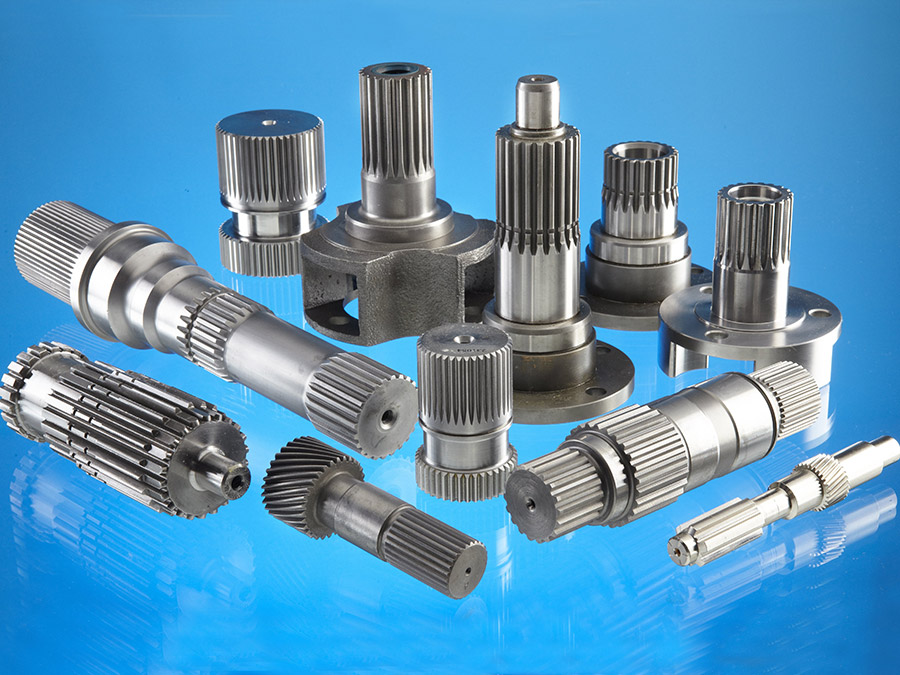
Can spline shafts be used in both mobile and stationary machinery?
Yes, spline shafts can be used in both mobile and stationary machinery. Here’s a detailed explanation:
1. Mobile Machinery:
Spline shafts find extensive use in various types of mobile machinery. For example:
- In Automotive Applications: Spline shafts are commonly used in automotive drivetrains, where they transmit torque from the engine to the wheels. They are found in components such as the transmission, differential, and axle shafts.
- In Construction and Earthmoving Equipment: Spline shafts are utilized in construction machinery, such as excavators, loaders, and bulldozers. They are employed in the powertrain systems to transfer torque and drive the hydraulic pumps or propel the machine.
- In Agricultural Equipment: Spline shafts are used in agricultural machinery like tractors, combines, and harvesters. They help transfer power from the engine to various driven components, such as the wheels, PTO (power take-off), or hydraulic systems.
- In Off-Road Vehicles: Spline shafts are present in off-road vehicles, including ATVs (all-terrain vehicles) and military vehicles. They enable power transmission to the wheels or drivetrain components, ensuring mobility and performance in challenging terrains.
2. Stationary Machinery:
Spline shafts are also widely employed in stationary machinery across various industries. Some examples include:
- In Machine Tools: Spline shafts are used in machine tools, such as lathes, milling machines, and grinding machines. They provide torque transmission in the spindle or lead screw mechanisms, enabling precision motion control and material removal operations.
- In Industrial Gearboxes: Spline shafts play a crucial role in industrial gearboxes used in manufacturing and processing plants. They transmit torque between input and output shafts, enabling speed reduction or increase as required by the application.
- In Power Generation: Spline shafts are utilized in power generation equipment, including turbines and generators. They help transmit torque between the rotating rotor and the stationary components, facilitating energy conversion.
- In Pump and Compressor Systems: Spline shafts are present in pumps and compressors used in various industries. They transmit torque from the motor or prime mover to the impeller or compressor elements, enabling fluid or gas transfer.
The versatility of spline shafts makes them suitable for a wide range of applications, both mobile and stationary. Their ability to efficiently transmit torque, accommodate misalignment, distribute loads, and provide reliable connections makes them a preferred choice in diverse machinery across industries.
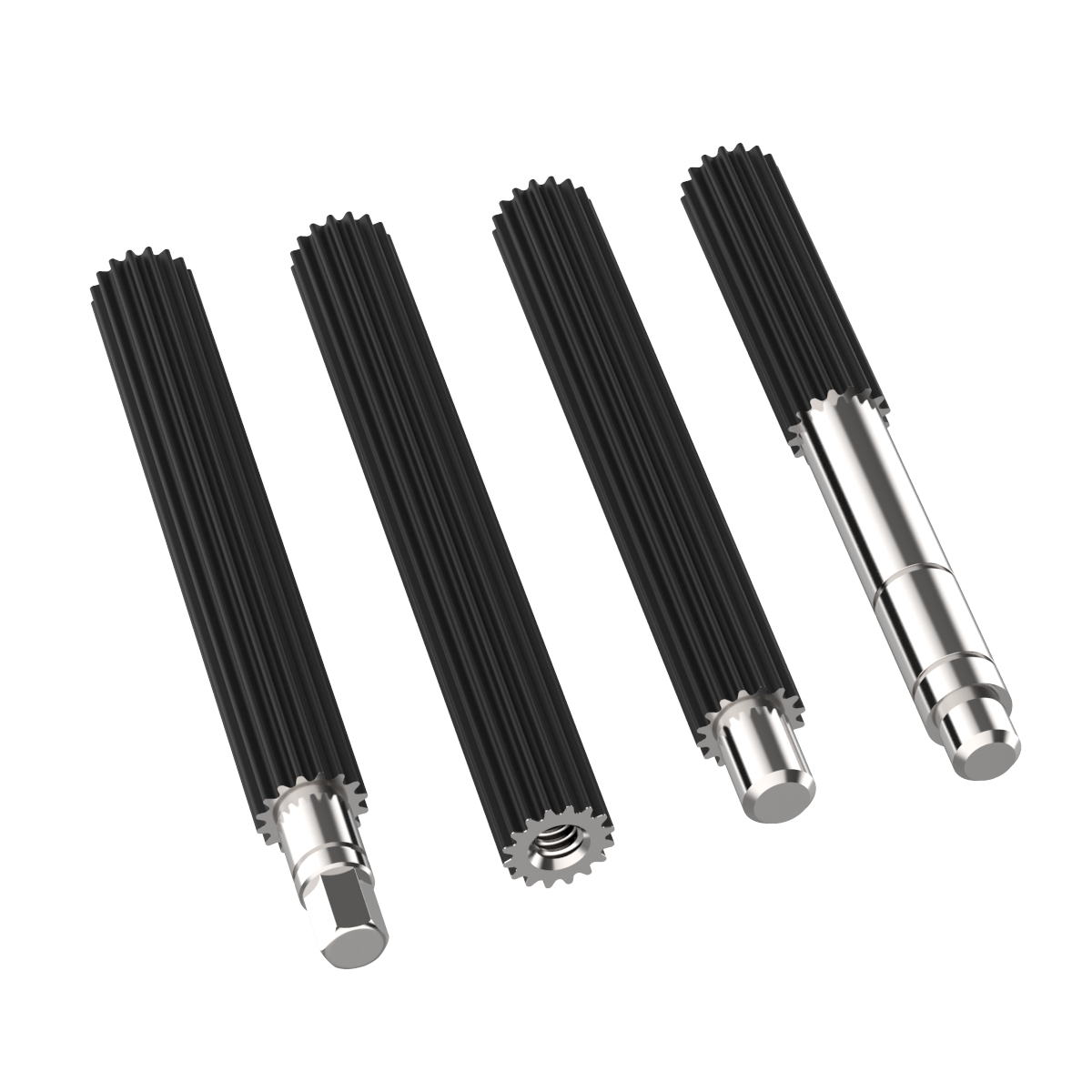
How do spline shafts contribute to precise and consistent rotation?
Spline shafts play a crucial role in achieving precise and consistent rotation in mechanical systems. Here’s how spline shafts contribute to these characteristics:
1. Interlocking Design:
Spline shafts feature a series of ridges or teeth, known as splines, that interlock with corresponding grooves or slots in mating components. This interlocking design ensures a positive connection between the shaft and the mating part, allowing for precise and consistent rotation. The engagement between the splines provides resistance to axial and radial movement, minimizing play or backlash that can introduce inaccuracies in rotation.
2. Load Distribution:
The interlocking engagement of spline shafts allows for effective load distribution along the length of the shaft. This helps distribute the applied torque evenly, reducing stress concentrations and minimizing the risk of localized deformation or failure. By distributing the load, spline shafts contribute to consistent rotation and prevent excessive wear on specific areas of the shaft or the mating components.
3. Torque Transmission:
Spline shafts are specifically designed to transmit torque efficiently from one component to another. The close fit between the splines ensures a high torque-carrying capacity, enabling the shaft to transfer rotational force without significant power loss. This efficient torque transmission contributes to precise and consistent rotation, allowing for accurate positioning and motion control in various applications.
4. Rigidity and Stiffness:
Spline shafts are typically constructed from materials with high rigidity and stiffness, such as steel or alloy. This inherent rigidity helps maintain the dimensional integrity of the shaft and minimizes deflection or bending under load. By providing a stable and stiff rotational axis, spline shafts contribute to precise and consistent rotation, particularly in applications that require tight tolerances or high-speed operation.
5. Alignment and Centering:
The interlocking nature of spline shafts aids in the alignment and centering of rotating components. The splines ensure proper positioning and orientation of the shaft relative to the mating part, facilitating concentric rotation. This alignment helps prevent wobbling, vibrations, and eccentricity, which can adversely affect rotation accuracy and consistency.
6. Lubrication and Wear Reduction:
Proper lubrication of spline shafts is essential for maintaining precise and consistent rotation. Lubricants reduce friction between the mating surfaces, minimizing wear and preventing stick-slip phenomena that can cause irregular rotation. The use of lubrication also helps dissipate heat generated during operation, ensuring optimal performance and longevity of the spline shaft.
By incorporating interlocking design, load distribution, efficient torque transmission, rigidity, alignment, and lubrication, spline shafts contribute to precise and consistent rotation in mechanical systems. Their reliable and accurate rotational characteristics make them suitable for a wide range of applications, from automotive and aerospace to machinery and robotics.
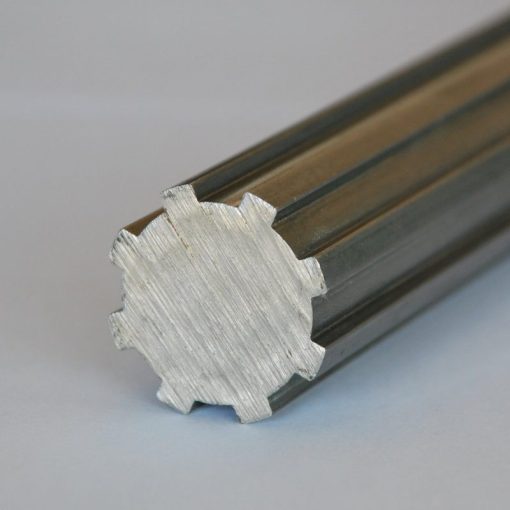
What is a spline shaft and what is its primary function?
A spline shaft is a mechanical component that consists of a series of ridges or teeth (called splines) that are machined onto the surface of the shaft. Its primary function is to transmit torque while allowing for the relative movement or sliding of mating components. Here’s a detailed explanation:
1. Structure and Design:
A spline shaft typically has a cylindrical shape with external or internal splines. The external spline shaft has splines on the outer surface, while the internal spline shaft has splines on the inner bore. The number, size, and shape of the splines can vary depending on the specific application and design requirements.
2. Torque Transmission:
The main function of a spline shaft is to transmit torque between two mating components, such as gears, couplings, or other rotational elements. The splines on the shaft engage with corresponding splines on the mating component, creating a mechanical interlock. When torque is applied to the spline shaft, the engagement between the splines ensures that the rotational force is transferred from the shaft to the mating component, allowing the system to transmit power.
3. Relative Movement:
Unlike other types of shafts, a spline shaft allows for relative movement or sliding between the shaft and the mating component. This sliding motion can be axial (along the shaft’s axis) or radial (perpendicular to the shaft’s axis). The splines provide a precise and controlled interface that allows for this movement while maintaining torque transmission. This feature is particularly useful in applications where axial or radial displacement or misalignment needs to be accommodated.
4. Load Distribution:
Another important function of a spline shaft is to distribute the applied load evenly along its length. The splines create multiple contact points between the shaft and the mating component, which helps to distribute the torque and axial or radial forces over a larger surface area. This load distribution minimizes stress concentrations and reduces the risk of premature wear or failure.
5. Versatility and Applications:
Spline shafts find applications in various industries and systems, including automotive, aerospace, machinery, and power transmission. They are commonly used in gearboxes, drive systems, power take-off units, steering systems, and many other rotational mechanisms where torque transmission, relative movement, and load distribution are essential.
6. Design Considerations:
When designing a spline shaft, factors such as the torque requirements, speed, applied loads, and environmental conditions need to be considered. The spline geometry, material selection, and surface finish are critical for ensuring proper engagement, load-bearing capacity, and durability of the spline shaft.
In summary, a spline shaft is a mechanical component with splines that allows for torque transmission while accommodating relative movement or sliding between mating components. Its primary function is to transmit rotational force, distribute loads, and enable axial or radial displacement in various applications requiring precise torque transfer and flexibility.


editor by CX 2024-05-14