
Product Description
| Material: | Aluminum (6061-T6, 6063, 7075-T6,5052) etc… Brass/Copper/Bronze etc… Stainless Steel (302, 303, 304, 316, 420) etc… Steel (mild steel, Q235, 20#, 45#) etc… Plastic (ABS, Delrin, PP, PE, PC, Acrylic) etc… |
| Process: | CNC Machining, CNC Turning, CNC Milling, CNC Lathe, CNC boring, CNC grinding, CNC drilling etc… |
| Surface treatment: | Clear/color anodized; Hard anodized; Powder-coating; Sand-blasting; Painting; Nickel plating; Chrome plating; Zinc plating; Silver/golden plating; Black oxide coating, Polishing etc… |
| General Tolerance: (+/-mm) |
+/-0.001mm or +/- 0.00004″ |
| Certification: | ISO9001:2008, TS-16949 |
| Experience: | 15years of CNC machining products 3years of automation machine manufacturing |
| Lead time : | In general:7-15days Special custom service: making arrangement CHINAMFG customers’ request |
| Minimum Order: | Comply with customer’s demand |
| Packaging : | Standard: pearl cotton and bubble bag, carton box and seal For large and big quantity: pallet or as per customers’ requirement |
| Term of Payment: | T/T, Paypal, Trade assurance etc… |
| Delivery way: | Express(DHL,Fedex, UPS,TNT,EMS), By Sea, By air, or on your requirement |
| Maine equipment: |
Machining center, CNC, Lathe, Turning machine, Milling machine, Drilling machine, Internal and external grinding machine, Cylindrical grinding machine, Tapping drilling machine, Wire cutting machine etc. |
| Testing facility: |
Coordinate measuring machine, projector, roughness tester, hardness tester, concentricity tester. Height tester |
| Item Tag: |
mini cnc milling machine for sale |
1.Q:Are you trading company or manufacturer?
A: We are factory with more then 15years experience
2.Q: How long is your delivery time?
A: Generally it is 15-30days as we are Customized service we confirm with Customer
when place order
3.Q:Do you provide samples? ls it free or extra?
A: Yes we provide samples .for sample charge as per sample condition to decide free or
charged ,usually for not too much time used consumed machining process are free
4.Q:What is your terms of payment?
30% T/T in advance balance before shipment .Or as per discussion
5.Q: Can we know the production process without visiting the factory?
A:We will offer detailed production schedule and send weekly reports with digital
pictures and videos which show the machining progress
6.Q:Available for customized design drawings?
A: YesDWG.DXF.DXW.IGES.STEP. PDF etc
7.Q:Available for customized design drawings?
A: Yes ,we can CHINAMFG the NDA before your send the drawing
8.Q:How do you guarantee the quality?
A:(1) Checking the raw material after they reach our factory——
Incoming quality control(IQC)
(2) Checking the details before the production line operated
(3) Have a full inspection and routing inspection during mass production—
In-process quality control(IPQC)
(4) Checking the goods after they are finished—- Final quality control(FQC)
(5) Checking the goods after they are finished—–Outgoing quality control(QC)
(6)100% inspection and delivery before shipment.
/* March 10, 2571 17:59:20 */!function(){function s(e,r){var a,o={};try{e&&e.split(“,”).forEach(function(e,t){e&&(a=e.match(/(.*?):(.*)$/))&&1
| Material: | Carbon Steel |
|---|---|
| Load: | Drive Shaft |
| Stiffness & Flexibility: | Flexible Shaft |
| Journal Diameter Dimensional Accuracy: | IT01-IT5 |
| Axis Shape: | Straight Shaft |
| Shaft Shape: | Stepped Shaft |
| Samples: |
US$ 1/Piece
1 Piece(Min.Order) | |
|---|
| Customization: |
Available
| Customized Request |
|---|
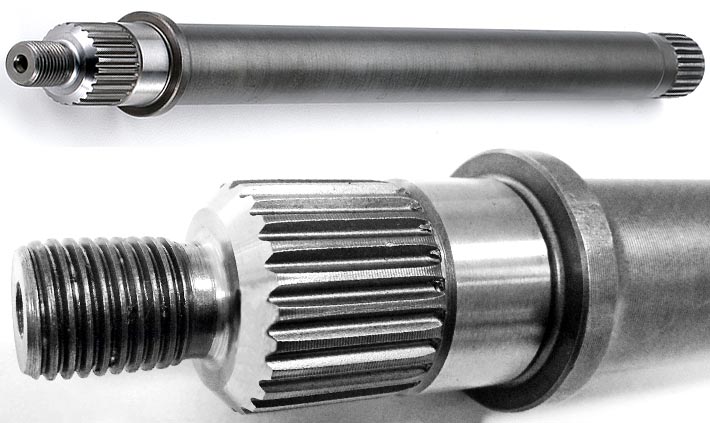
How do spline shafts handle variations in torque and rotational force?
Spline shafts are designed to handle variations in torque and rotational force in mechanical systems. Here’s a detailed explanation:
1. Interlocking Splines:
Spline shafts have a series of interlocking splines along their length. These splines engage with corresponding splines on the mating component, such as gears or couplings. The interlocking design ensures a secure and robust connection, capable of transmitting torque and rotational force.
2. Load Distribution:
When torque is applied to a spline shaft, the load is distributed across the entire engagement surface of the splines. This helps to minimize stress concentrations and prevents localized wear or failure. The load distribution capability of spline shafts allows them to handle variations in torque and rotational force effectively.
3. Material Selection:
Spline shafts are typically made from materials with high strength and durability, such as alloy steels. The material selection is crucial in handling variations in torque and rotational force. It ensures that the spline shaft can withstand the applied loads without deformation or failure.
4. Spline Profile:
The design of the spline profile also contributes to the handling of torque variations. The spline profile determines the contact area and the distribution of forces along the splines. By optimizing the spline profile, manufacturers can enhance the load-carrying capacity and improve the ability of the spline shaft to handle variations in torque.
5. Surface Finish and Lubrication:
Proper surface finish and lubrication play a crucial role in the performance of spline shafts. A smooth surface finish reduces friction and wear, while suitable lubrication minimizes heat generation and ensures smooth operation. These factors help in handling variations in torque and rotational force by reducing the impact of friction and wear on the spline engagement.
6. Design Considerations:
Engineers take several design considerations into account to ensure spline shafts can handle variations in torque and rotational force. These considerations include appropriate spline dimensions, tooth profile geometry, spline fit tolerance, and the selection of mating components. By carefully designing the spline shaft and its mating components, engineers can optimize the system’s performance and reliability.
7. Overload Protection:
In some applications, spline shafts may be equipped with overload protection mechanisms. These mechanisms, such as shear pins or torque limiters, are designed to disconnect the drive temporarily or slip when the torque exceeds a certain threshold. This protects the spline shaft and other components from damage due to excessive torque.
Overall, spline shafts handle variations in torque and rotational force through their interlocking splines, load distribution capability, appropriate material selection, optimized spline profiles, surface finish, lubrication, design considerations, and, in some cases, overload protection mechanisms. These features ensure efficient torque transmission and enable spline shafts to withstand the demands of various mechanical systems.
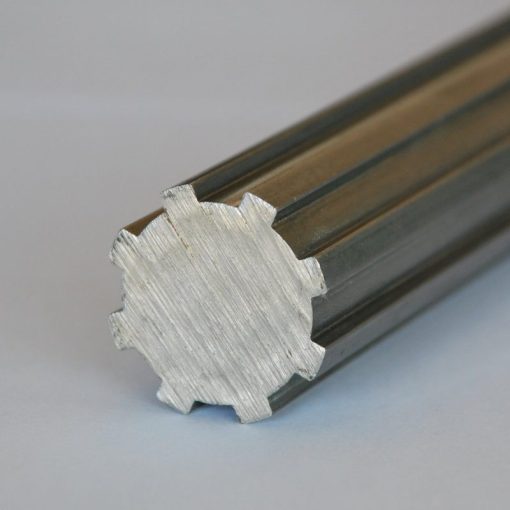
How do spline shafts handle variations in environmental conditions?
Spline shafts are designed to handle variations in environmental conditions and maintain their performance and reliability. Here’s a detailed explanation:
1. Temperature Variations:
Spline shafts are engineered to withstand a wide range of temperature variations. They are constructed from materials that exhibit good thermal stability, such as high-grade steels or alloys. These materials have low coefficients of thermal expansion, minimizing the effects of temperature changes on the shaft’s dimensional stability. Additionally, proper lubrication with temperature-resistant lubricants helps reduce friction and wear in the spline engagement, even under extreme temperature conditions.
2. Moisture and Corrosion Resistance:
Spline shafts can be designed to resist moisture and corrosion, ensuring their performance in humid or corrosive environments. Protective coatings, such as platings or surface treatments, can be applied to the shaft’s surfaces to enhance their resistance to moisture, oxidation, and corrosion. Additionally, selecting materials with inherent corrosion resistance, such as stainless steel or specialized alloys, can further enhance the spline shaft’s ability to handle environmental conditions.
3. Dust and Contaminant Protection:
Spline shafts used in environments with high levels of dust, dirt, or contaminants can be equipped with protective measures. Seals, gaskets, or covers can be employed to prevent the ingress of particles into the spline engagement. These protective measures help maintain the integrity of the spline profile, minimize wear, and ensure smooth operation even in dirty or dusty conditions.
4. Lubrication and Maintenance:
Proper lubrication is essential for the reliable operation of spline shafts, especially in challenging environmental conditions. Lubricants with appropriate viscosity and additives can be selected to provide effective lubrication and protection against wear, friction, and corrosion. Regular maintenance and lubrication intervals should be followed to ensure optimal performance and longevity of the spline shaft.
5. Shock and Vibration Resistance:
Spline shafts are designed to withstand shock and vibration encountered in various applications. The spline engagement and shaft design can incorporate features such as tighter tolerances, increased contact area, or damping elements to minimize the effects of shock and vibration. Additionally, proper fastening and mounting techniques help secure the shaft and reduce the risk of loosening or failure due to dynamic loads.
6. Environmental Sealing:
In certain applications where spline shafts are exposed to harsh environmental conditions, such as underwater or in chemical environments, environmental sealing can be employed. Sealing methods such as O-rings, gaskets, or specialized seals provide an additional barrier against external elements, ensuring the integrity and performance of the spline shaft.
7. Compliance with Standards:
Spline shafts used in specific industries or applications may need to comply with industry standards or regulations regarding environmental conditions. Manufacturers can design and test their spline shafts to meet these requirements, ensuring that the shafts can handle the specified environmental conditions and perform reliably.
By incorporating design considerations, appropriate materials, protective coatings, lubrication, and maintenance practices, spline shafts can effectively handle variations in environmental conditions. This enables them to maintain their functionality, performance, and longevity even in challenging operating environments.
What is a spline shaft and what is its primary function?
A spline shaft is a mechanical component that consists of a series of ridges or teeth (called splines) that are machined onto the surface of the shaft. Its primary function is to transmit torque while allowing for the relative movement or sliding of mating components. Here’s a detailed explanation:
1. Structure and Design:
A spline shaft typically has a cylindrical shape with external or internal splines. The external spline shaft has splines on the outer surface, while the internal spline shaft has splines on the inner bore. The number, size, and shape of the splines can vary depending on the specific application and design requirements.
2. Torque Transmission:
The main function of a spline shaft is to transmit torque between two mating components, such as gears, couplings, or other rotational elements. The splines on the shaft engage with corresponding splines on the mating component, creating a mechanical interlock. When torque is applied to the spline shaft, the engagement between the splines ensures that the rotational force is transferred from the shaft to the mating component, allowing the system to transmit power.
3. Relative Movement:
Unlike other types of shafts, a spline shaft allows for relative movement or sliding between the shaft and the mating component. This sliding motion can be axial (along the shaft’s axis) or radial (perpendicular to the shaft’s axis). The splines provide a precise and controlled interface that allows for this movement while maintaining torque transmission. This feature is particularly useful in applications where axial or radial displacement or misalignment needs to be accommodated.
4. Load Distribution:
Another important function of a spline shaft is to distribute the applied load evenly along its length. The splines create multiple contact points between the shaft and the mating component, which helps to distribute the torque and axial or radial forces over a larger surface area. This load distribution minimizes stress concentrations and reduces the risk of premature wear or failure.
5. Versatility and Applications:
Spline shafts find applications in various industries and systems, including automotive, aerospace, machinery, and power transmission. They are commonly used in gearboxes, drive systems, power take-off units, steering systems, and many other rotational mechanisms where torque transmission, relative movement, and load distribution are essential.
6. Design Considerations:
When designing a spline shaft, factors such as the torque requirements, speed, applied loads, and environmental conditions need to be considered. The spline geometry, material selection, and surface finish are critical for ensuring proper engagement, load-bearing capacity, and durability of the spline shaft.
In summary, a spline shaft is a mechanical component with splines that allows for torque transmission while accommodating relative movement or sliding between mating components. Its primary function is to transmit rotational force, distribute loads, and enable axial or radial displacement in various applications requiring precise torque transfer and flexibility.


editor by CX 2024-01-31